Monday, July 9, 2007

Sunday, July 8, 2007
Rwandan University Life
I too am struggling though with how to process the emotional impact of seeing the destruction of a human life. This weekend, my cup over spilled. Murambi Memorial, the most graphic and overwhelming genocide memorial. Murambi is a village high up on a scenic plateau. It used to be the site of a rural secondary school. During the genocide, Tutsi’s and moderate Hutu's were told to take refuge in the school; they were informed that they would be safe. Nearly 50,000 people fled to the school but they were not safe. The sheer number of victims was overwhelming; the natural beauty that silently witnessed the massacre was disturbing; our tour guide who was the only surviving member of his family and who has stayed on as groundskeeper ever since 1994 was painful; the plaque recognizing the site where French troops had played volley ball during Operation Turquoise was enraging(Operation Turquoise is an infuriating research topic for anyone interested in learning more about the international role in the 1994 genocide. A French documentary entitled Operation Turquoise was being filmed in Butare during our stay and should be out soon); the memorial was more than my soul could take. Like other memorials, the site remained untouched and unchanged. Yet, at Murambi the victims had not been moved. The last moment of life was seen on their mummified faces. I could never be prepare to face what I saw as I walked into one room after another. The odor was overwhelming, but it was not the odor of death, it was the odor of sheer evil. I wish I could end by saying a blank comment like, may they rest in peace, but I fear that the victims do not rest in peace.
Thursday, July 5, 2007
Education in Rwanda
To Congo and Quickly Back
Gysini, Rwanda is on Lake Kivu and shares a boarder with Goma, Congo. Travel across the boarder is unadvisable, but we organized a guide to take a group of us across for the day. The Rwandan genocide of 1994 is not a closed issue; it has merely spilled over the boarder into Congo. The Hutu militia, Interhamwe, has fled into the DRC and continues to violently target various groups within the Congolese population. Yet, such stories are only a peep in the international media. As we walked across the boarder, I could feel a change in atmosphere. The people were visible upset by our presence and would glare as we walked by. Goma is still in a state of utter disarray ever since the 2003 volcanic irruption. A line runs though the town outlining the destructive lava flow. In addition to the piles of volcanic destruction, the streets were absolutely littered with trash. Amidst the trash, ostentatious homes spotted the streets. The severe separation between economic classes made my stomach turn. A haunting billboard displayed a picture of a Caucasian baby advertising diapers yet the children scampering around on the streets rarely even had shoes or pants. Mercedes sped about the streets and in the driver’s seat was often a male of Indian or Middle Easter descent. The blue-beret UN official that marched around were also mostly from India and the Middle East which I flagged mentally as a further research topic? The UN seems to hold a strong presence, in Goma at least. Countless UN vehicles went back and forth along the main street and a UN sponsored refugee camp was tucked in between the lake and the Rwandan boarder. The condition of the camp seemed to be nice, especially in comparison to the refugee camp we had visited the previous day on the Rwandan side.
I just read a statistic placing Rwanda as the poorest country in Eastern Africa. The level of development in Rwanda is remarkable given socio-political strife but they really have no internal industry. The only substantial export is coffee, yet the country does not have the infrastructure to process and distribute what they grow. Economic development is a priority amongst the entire population. In the case of DRC, it is one of the most resource rich countries in all of Africa and yet it reeks of corruption. Rwanda: violent conflict amongst a population struggling under the weight of severe poverty and resource scarcity; Congo: violent conflict amongst a population cursed with resource abundance. There is so much I have to say, all for now though.
Amahoro (Peace)
Wednesday, June 27, 2007
Nyamata Memorial Visits
Juxtaposed to the memorial sites, we visited a couple different development project sites. The first was near-and-dear to my heart. It was a NGO and government sponsored project to help fight poverty and malnutrition by building sustainable stoves. The stoves were made out of a creative mixture of sand and mud that with a limited amount of heat could stay warm for hours. This project has supplied people with jobs, clean boiled water, and they use about ¾ less firewood which is a benefit to the environment and also to the women and girls who have to go far distances to collect firewood. Now, instead of collecting wood, the girls are able to go to school! Some of the villages nearby have received large stoves in the school so that the children are able to receive sustenance during the school day. Amazing huh! When asked how the stove project has helped to create peace and reconciliation, the villagers responded that making the stoves has pulled them together and has given them hope for the future. Their children study together and are growing into a collaborative existence.
Sunday, June 24, 2007
A Portrait of Kigali, Rwanda
In the furry of my thoughts, in the previous entry I failed to introduce you to my temporary home so welcome to Rwanda!
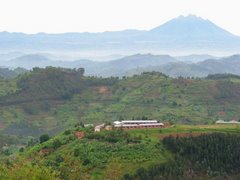
Sitting and watching the street activity has given me one of the most poignant summaries of the country, its history, prospects for the future, and of Rwandan living. The city streets weave around lush, green, hilly country side. The cool climate and green beauty has surprised and impressed me almost as much as the beauty of the people.
I don’t always feel welcome though. As I walk down the streets I am greeted by calls of mozungo-white person. The first time I heard this title used I was out for an early morning walk. I hung my shoulders and wanted to pull my black jacket up over my face. I felt targeted, uncomfortable, and like an invader. Accenting physical differences to create separation/segregation is painful. In that moment of personal discomfort I experienced the years of pain and segregation that the Rwandan people have carried. As I turned to find my caller I spotted an elderly man grinning with a toothless smile and waving energetically; my pain was self-imposed. Since then I have been hollered at countless times. Sometimes in a friendly/curious manner and sometimes it is yelled from behind a frown and stern eyes. The white skin of German, French, and
Saturday, June 23, 2007
I have arrived!
I am about to finish my first week in this remarkable country and I have much to share. My mind and heart are teeming. Where to begin?! Our delegation took the first few days to become oriented with our purpose here and with the city of Kigali. During one intensely memorable day, we went from visiting the Kigali Genocide Memorial to a reception at a primary school. The memorial site was emotionally overwhelming. I walked away feeling confusion, resentment, anger, sadness, pain, disbelief, guilt, and overwhelming grief.
While in a conversation with a young Rwandan man, the topic of the 1994 genocide came up and he hung his head while asking: “What does the outside world think of a country in which the people killed their own neighbors, teachers, doctors, brothers, wives, and children?” The pain and guilt that saturated his question made my heart ache. What do I think? What I have seen and experienced is a country of great resilience. The Rwandans are dealing with a tragic history in a manner that in commendable. The government has abolished the death penalty exposing the human ability to forgive; and the citizens have enacted a judicial system (Gacacas) which looks to have the people try one another and then reintegrate the genocidiares back into the society.
Ever since stepping off the plane, I have been received with open arms. Slowly I have accepted this warm reception. The first morning I timidly poked my head out of the steel gate which surrounded our lodging. My eyes rested upon a whole new world, but as I blinked and looked again I realized that it is not all that different. There are elements of humanity that cross all boarders, oceans, and time-zones. We are in this experience called life together, how amazingly exciting! Stay posted for more! Now that I have figured out the internet situation, I hope to make more frequent postings.
Amahoro (Peace)